What is Conversational Commerce? And Why It Is Replacing Traditional Online Stores

What is Conversational Commerce? And Why It Is Replacing Traditional Online Stores
Millions of sellers are moving away from product pages and shopping carts toward something that feels more natural and converts far better. This guide explains what conversational commerce is, how it works, why it is growing fastest in Africa and emerging markets, and what it means for any seller running their business on WhatsApp or Instagram today.
There is a seller somewhere in Accra right now answering the same five WhatsApp messages she has answered every single day for the past two years. “Do you have this in red?” “How much is delivery to Tema?” “Can I pay by MoMo?” “Is this still available?” “When will it arrive?”
Between those messages, she is managing Instagram DMs, reposting price lists on her story, chasing unpaid orders, updating customers on delivery timelines, and somehow finding time to restock, photograph, and list new products. She is doing all of this manually, in real time, on her phone, seven days a week.
She is not running a business poorly. She is running a business that has no automation. She has customers who want to buy, products they want to buy, and a genuine income-generating operation. What she does not have is a system that handles the repetitive, conversational, question-answering, order-taking part of selling so that she can focus on the parts that actually require her attention.
Conversational commerce is the category of technology that solves that exact problem. And in 2026, it has moved from a niche innovation into the mainstream model for how small businesses in WhatsApp-dominant markets sell online.
What Conversational Commerce Actually Means
Conversational commerce is the practice of selling products and services through conversation. Instead of directing a customer to a website where they browse alone, add items to a cart, and navigate a checkout funnel by themselves, conversational commerce guides the customer through the buying process inside a natural back-and-forth dialogue.
That dialogue can happen on WhatsApp, Instagram DM, Facebook Messenger, a website chat widget, or increasingly through AI agents that manage the entire conversation without any human involvement from the seller.
The term was first used publicly by Uber’s Chris Messina in a 2015 Medium post where he predicted that messaging apps would become the primary interface for commerce, replacing traditional app-and-website models as smartphones became the dominant computing device globally. He was correct. It took roughly a decade, the maturation of mobile money infrastructure in emerging markets, and a generation of AI capable of genuine natural language understanding to prove it at scale. But the shift is now well underway.
In practical terms, conversational commerce in 2026 means:
- An AI agent on WhatsApp that answers any product question, recommends the right item, builds a cart, collects delivery details, and processes payment without the seller doing anything
- A storefront where the primary interface is a conversation rather than a product grid and shopping cart
- A customer experience that resembles talking to a knowledgeable shop assistant who is available at any hour of the day
- Commerce that happens where the customer already spends time, inside their messaging app, rather than requiring them to navigate somewhere new
“In 2026, conversational commerce means agentic AI that operates proactively across website, WhatsApp, Instagram, and email from one knowledge base. The distinction between answering questions and guiding a sale has collapsed.”
Zipchat AI, 2026 Conversational Commerce Strategy GuideThe Problem with Traditional Online Stores
Traditional e-commerce, the product-grid-to-shopping-cart-to-checkout model that companies like Amazon and Jumia built their businesses on, was designed around a set of assumptions that do not hold true for most small sellers in Africa and emerging markets.
The assumptions are: customers have reliable desktop or mobile internet, they are comfortable navigating unfamiliar websites, they have a card linked to an online payment system, they trust the seller enough to enter payment details on a page they have never visited before, and they are willing to complete a multi-step checkout process without assistance.
For a large, established retailer with a known brand, strong design, hundreds of reviews, and a seamless checkout, those assumptions often hold. For a small seller in Accra who set up a WooCommerce store last month, they frequently do not.
The friction compounds at every step:
- The homepage loads slowly on a mobile data connection
- The product photos are small and hard to zoom on a phone screen
- There is no one to ask whether the medium will fit
- The checkout requires creating an account before buying
- The payment gateway does not recognise the customer’s MoMo number as a valid payment method
- The customer gives up, closes the browser, and sends a WhatsApp message instead
That last step is the telling one. The customer defaulted to messaging because messaging is where they are comfortable. Conversational commerce formalises that default rather than fighting it.
- Customer navigates to a website they may not trust yet
- Searches or scrolls through product pages without help
- Has questions but no one to ask in real time
- Attempts a multi-step checkout alone
- Hits a payment method they do not have
- Abandons the cart and sends a WhatsApp message
Average e-commerce conversion rate: 1 to 3 percent of visitors
- Customer opens a link in their WhatsApp bio or Instagram
- Asks the AI agent a question in plain language
- Receives an instant, accurate, personalised answer
- AI builds the cart and collects delivery details in chat
- Pays via Mobile Money, Paystack, or Flutterwave in the same conversation
- Receives order confirmation and tracking automatically
Conversational commerce conversion rate: 12 to 45 percent of engaged conversations
How AI Changed the Equation
The idea of selling through conversation is not new. Live chat widgets have existed on websites since the early 2000s. WhatsApp Business launched in 2018. The concept of guiding a customer to purchase via messaging has been around for years.
What changed is the quality of AI that can hold those conversations.
Earlier chatbots were rule-based systems. A customer typed a keyword and the bot responded with a pre-written answer. These systems were brittle. If the customer phrased their question differently from the expected input, the bot would fail. If they asked something outside the predefined script, the bot would return an error message or a generic fallback. Customers quickly learned that chatbots were not worth talking to, and the technology developed a reputation for being more frustrating than helpful.
Modern large language models, the technology behind systems like Anthropic Claude (which powers Ama, the AI agent at the heart of ChatPadi), understand intent rather than just keywords. They can interpret “I want the blue one but I am between sizes, what do you think?” and respond with a genuinely useful recommendation based on your actual product sizing information. They can remember what was said earlier in the conversation. They can handle the natural, indirect, sometimes misspelled way that real customers actually communicate.
This is the technical shift that made conversational commerce viable at scale. Not the concept, which was always sound. The execution, which now actually works.
What modern AI agents can do in a sales conversation
- Understand a customer’s question regardless of how it is phrased or what language it is in
- Search your product catalogue in real time and return accurate information about availability, price, and specifications
- Make personalised product recommendations based on what the customer has described they want
- Build a cart across multiple messages as the customer adds and removes items
- Collect delivery information naturally within the conversation without a separate form
- Generate a payment request and send a confirmation once payment is received
- Handle objections, answer questions about your shipping and returns policy, and escalate to a human when genuinely needed
- Do all of this simultaneously for hundreds of customers at once, 24 hours a day
Why Africa Is the Fastest Growing Region for Conversational Commerce
The African Commerce Context
Africa is projected to post a 13.27% compound annual growth rate in conversational commerce between 2026 and 2031, the highest regional growth rate in the world. This is not a coincidence. The conditions that make conversational commerce work better than traditional e-commerce are present in Africa more acutely than almost anywhere else.
WhatsApp is not an optional channel in Sub-Saharan Africa. It is the internet for commerce. In Kenya, 97% of smartphone users are on WhatsApp. In Nigeria and South Africa, the figure is 95%. In Zimbabwe, WhatsApp accounts for 44% of all mobile internet usage. A 2026 World Bank and IFC report found that 78% of small business owners across Sub-Saharan Africa use WhatsApp as their primary sales channel, and businesses using WhatsApp as a digital sales tool reported 2.4 times higher monthly revenue growth than those not using digital messaging.
The commerce infrastructure that conversational commerce relies on, specifically mobile money, is also more mature in Africa than in most of the world. M-Pesa in Kenya, MTN MoMo across West Africa, and Airtel Money across East and Central Africa have created a payment layer that works on any phone, without a bank account or a card. Payment confirmation arrives inside the same messaging thread where the sale started. Conversational commerce did not introduce a new payment behaviour in Africa. It automated one that already existed.
What this means practically is that African sellers who move to conversational commerce are not asking their customers to change anything. They are not asking them to visit a new website, create an account, learn a new checkout flow, or pay with a card they may not have. They are serving customers in the channel those customers already use, through a conversation those customers already understand, with a payment method those customers already have on their phone.
The friction that kills conversion rates on traditional e-commerce websites is largely absent. The familiarity that builds trust in WhatsApp-based commerce is already present. Conversational commerce simply adds the automation layer that removes the seller from the equation so that the business can operate at any hour without the seller being personally available.
What the Full Customer Journey Looks Like
Here is a concrete example of how conversational commerce works through a platform like ChatPadi, from the moment a customer discovers a seller to the moment their order is confirmed and paid.
The seller’s experience during this entire transaction: Nothing. Ama handled it. The seller might be sleeping, preparing stock, or running another order when this conversation happens. They find out about the new order when they check their dashboard or receive the notification email. This is the core value of conversational commerce done properly: the selling happens whether or not the seller is available.
Conversational Commerce versus Traditional E-Commerce: The Key Differences
It is worth being specific about where conversational commerce differs from traditional online retail, because the differences are structural rather than cosmetic.
The interface is a conversation, not a navigation
Traditional e-commerce puts the customer in control of navigation. They choose where to click, what to filter, how to sort. This works well for customers who know what they want and are confident navigating digital interfaces. It fails for customers who have questions, want recommendations, or find website navigation on a mobile device frustrating. Conversational commerce replaces navigation with dialogue. The customer says what they want in plain language and the system finds it for them.
The relationship is ongoing, not transactional
A traditional website checkout is a one-off transaction. A conversation is a relationship. When a customer messages a business on WhatsApp or chats through a conversational storefront, that conversation history persists. Future interactions can reference what the customer bought before, what they asked about, what they were interested in. This continuity enables personalisation that a product grid and checkout funnel structurally cannot provide.
Payment happens in context
In a traditional online store, payment is a separate step at the end of a funnel. It requires the customer to leave the browsing experience, enter payment details, and complete a checkout form. In conversational commerce, payment is part of the conversation. The payment instruction or link is sent within the chat. The customer completes it without leaving the context of the interaction. This reduction in friction is one of the primary reasons conversion rates in conversational commerce are consistently higher than in traditional e-commerce.
It works where customers already are
Building a traditional online store requires customers to come to you: to visit your domain, learn your site’s navigation, and trust your unfamiliar checkout. Conversational commerce goes where customers already spend time. On WhatsApp, where 78% of Sub-Saharan African small business owners already operate. On Instagram, where millions of African consumers already discover products. The barrier to the first interaction is almost zero because the customer is already in the app.
The History and Evolution of Conversational Commerce
Understanding how this category developed helps clarify why 2026 is the moment it has become mainstream rather than niche.
2015: Chris Messina coins the term “conversational commerce” and predicts that messaging apps will become primary commerce interfaces as smartphones displace desktop computers globally.
2016 to 2018: First-generation chatbots proliferate on Facebook Messenger and websites. Most are rule-based, brittle, and frustrating. The technology earns a poor reputation for customer experience even as the underlying idea gains traction among forward-thinking businesses.
2018: WhatsApp Business launches, giving small businesses official tools to manage customer conversations at scale. Adoption in Africa, India, and Brazil is immediate and substantial.
2020 to 2022: Large language model AI begins maturing. GPT-3 demonstrates that AI can hold genuinely useful natural language conversations. The gap between what chatbots can do and what customers need narrows dramatically.
2023 to 2024: AI capabilities reach the point where an agent can manage an entire sales conversation without human supervision. Platforms built on top of these models begin entering the market for small and medium businesses, not just enterprise clients.
2025 to 2026: Consumer spending through conversational commerce channels reaches $290 billion globally. Africa posts the highest regional growth rate. Eighty-four percent of e-commerce brands globally now treat conversational commerce as a strategic pillar. The category has moved from early adopter territory into mainstream commercial practice.
Common Questions About Conversational Commerce
Is it just a chatbot?
No, and this distinction matters. A traditional chatbot is a rule-based system that matches inputs to pre-written responses. It breaks when the customer phrases something unexpectedly. A modern AI agent in conversational commerce uses a large language model to understand intent, context, and nuance in the way a human would. The practical difference is significant: a chatbot would fail if a customer wrote “do u have d red one in small pls”, while a modern AI agent understands the request perfectly and responds helpfully.
Does it replace the seller entirely?
No. It replaces the repetitive, scalable part of selling: answering standard questions, taking orders, processing payments, sending confirmations. The parts that genuinely require human judgment, such as resolving a complex complaint, negotiating a bulk order, or building a long-term customer relationship, remain with the seller. The goal is not to remove the human from the business but to give the human their time back by automating everything that does not require their specific judgment.
Do customers mind talking to an AI?
Research consistently shows that customers care less about whether they are talking to a human or an AI and more about whether they get a fast, accurate, helpful response. A 2026 survey found that 66% of consumers are comfortable making purchases through messaging, and 69% are more likely to buy from brands that use WhatsApp as a communication channel. What customers object to is slow, unhelpful, or robotic responses. A well-configured AI agent avoids all three.
What if a customer asks something the AI cannot answer?
Good conversational commerce platforms include escalation logic. When Ama encounters a question she genuinely cannot answer, or a situation that requires human judgment, she flags it and notifies the seller. The seller can step into the conversation directly. This handoff preserves the automation for the 80 to 90 percent of interactions that are standard, while ensuring genuinely complex situations reach a human.
What This Means If You Currently Sell on WhatsApp
If you are currently taking orders through WhatsApp manually, you are already doing conversational commerce. You are answering product questions, building customer carts, collecting delivery details, sending payment instructions, and confirming orders. The difference between what you are doing and what a platform like ChatPadi provides is that you are doing all of those things yourself, one customer at a time, limited to the hours you are awake and the pace at which you can type.
Conversational commerce automates that work. Your products, prices, policies, and payment methods are configured once. Ama handles every incoming conversation from that point forward. You receive a notification when an order is placed and confirmed. You see the order dashboard when you are ready to process fulfilment. You can start for free and upgrade as your volume grows. Everything in between happens automatically.
The question for any WhatsApp seller is not whether conversational commerce is relevant to their business. It demonstrably is, because they are already doing it. The question is whether they want to keep doing it manually, one message at a time, or whether they want a system that does it for them.
Keep reading on the ChatPadi blog
Your Store, Automated
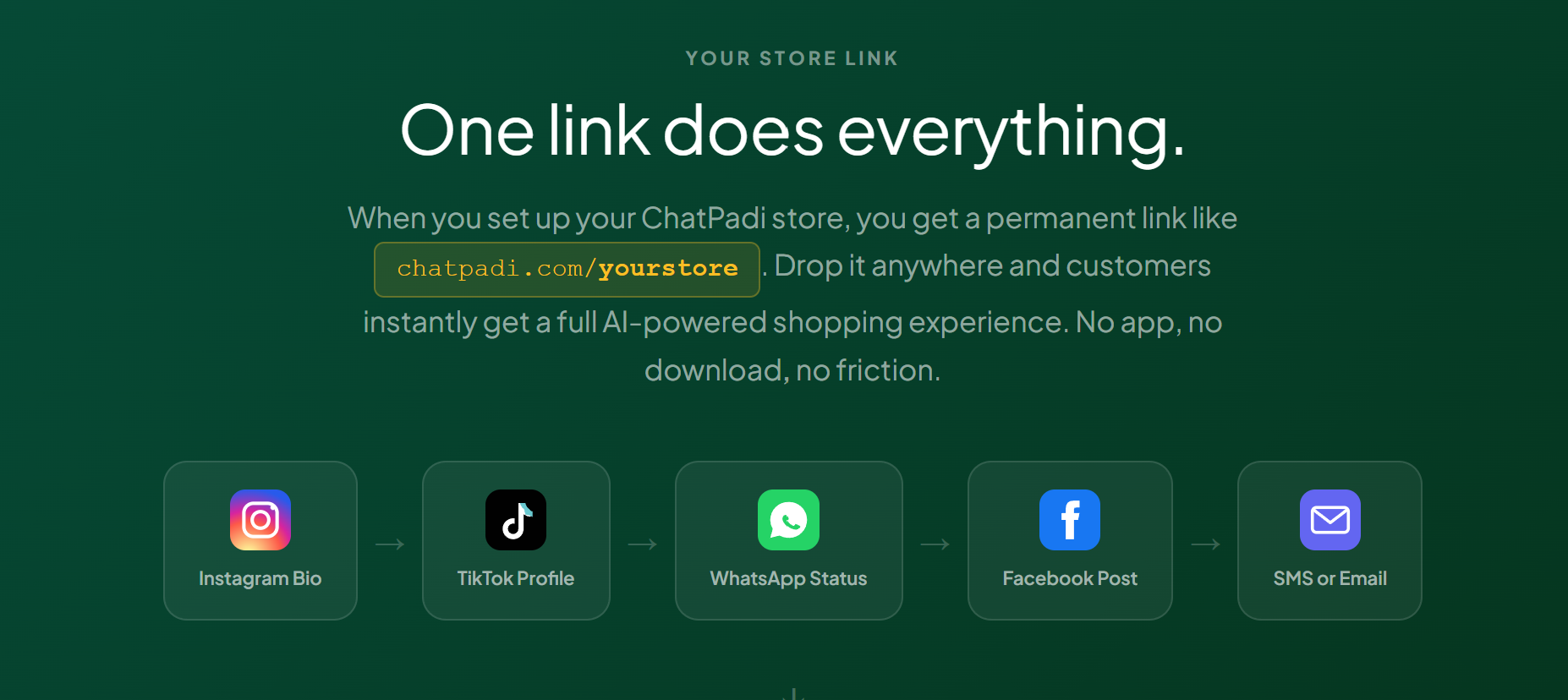
ChatPadi gives you a shareable store link and an AI agent called Ama who handles every customer conversation automatically. Set up your store in under 10 minutes. Share your link. Let Ama take it from there.
Start Your Free StoreFree to start. No credit card required. Live in under 10 minutes.