ChatPadi vs Jumia: Selling Directly vs Selling on a Marketplace
ChatPadi vs Jumia: Selling Directly vs Selling on a Marketplace
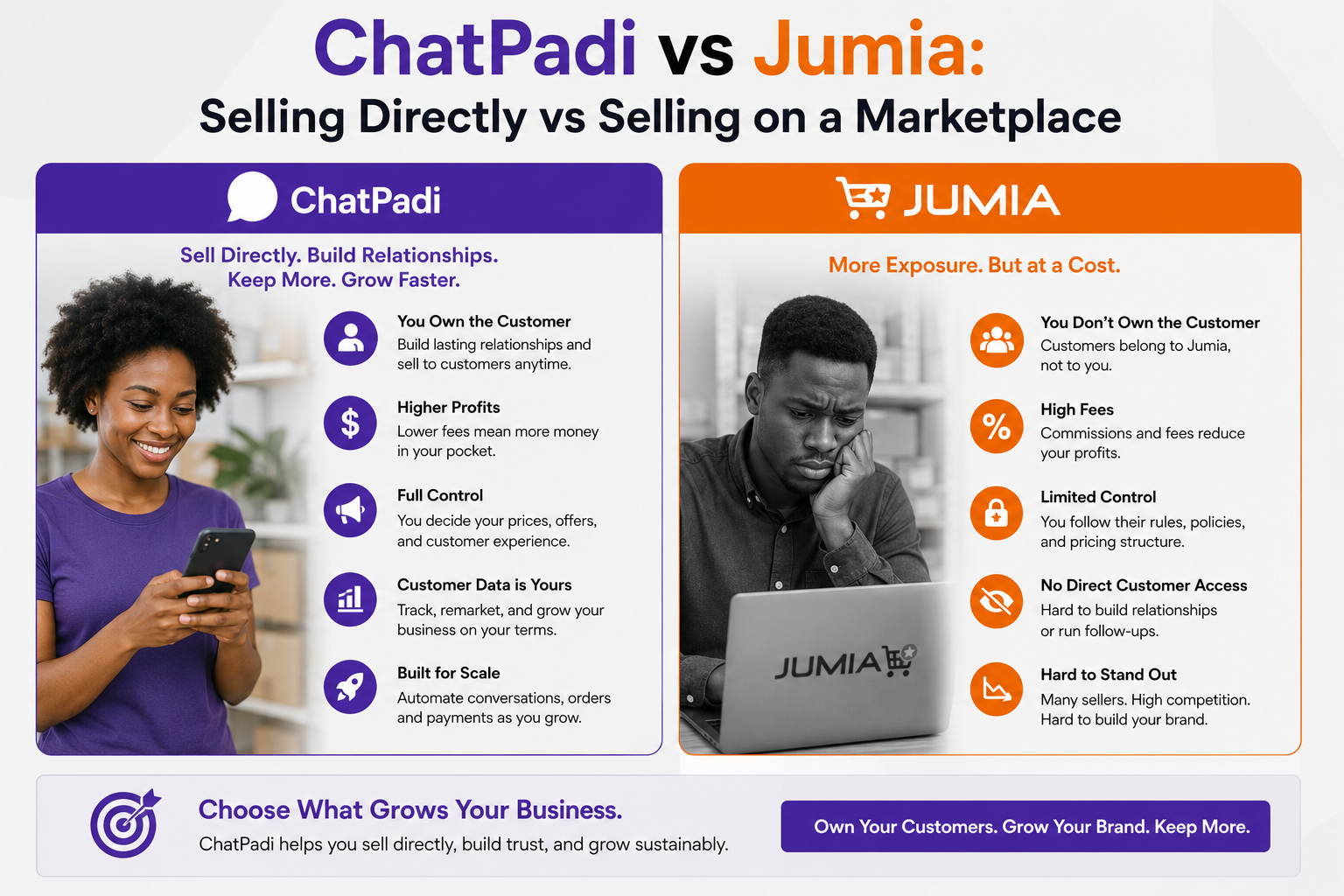
Jumia gives you access to millions of shoppers already browsing the platform. It also takes a commission on every sale, puts you in direct price competition with every other seller of the same product, and gives you no control over the customer relationship. ChatPadi gives you your own storefront and direct customer relationships, but you bring your own traffic. This guide breaks down exactly when each model makes sense.
These two models are not really competitors in the traditional sense. They represent two fundamentally different approaches to selling online: rent visibility on someone else’s platform, or build your own. Many successful sellers across Africa eventually use both, for different reasons. This guide explains exactly what each model costs, what each gives up, and how to decide which fits your business right now.
How Jumia’s Commission Structure Actually Works
The first thing every seller needs to understand about Jumia is that registration is free, but every sale carries a commission, and that commission varies significantly by product category and country. Commission rates across Jumia’s African markets commonly range from around 5% for some categories up to 20% or more for others, with additional fixed fees layered on top in several markets.
A worked example: Jumia Ghana, 20% commission category
That worked example, taken directly from Jumia’s own Ghana vendor documentation, shows the mechanics clearly: to actually receive GHS 950, the seller has to list the product at GHS 1,198, with Jumia retaining roughly GHS 248 of that final price. In Nigeria, Jumia also applies a minimum commission of approximately $1 per sale (roughly N1,600 at current exchange rates) regardless of category percentage, meaning very low-priced items can become effectively unprofitable on the platform unless used deliberately as loss leaders to drive traffic toward higher-margin products.
The pricing math is unavoidable: Every Jumia commission has to be built into your listed price, which means your product is more expensive on Jumia than it would be if sold directly, or your margin shrinks to absorb the commission. Either way, the commission is a real, ongoing cost on every single transaction, for as long as you sell through the platform.
What You Give Up Beyond the Commission
The commission is the most visible cost of selling on Jumia, but it is not the only one. Several structural trade-offs come with marketplace selling that are easy to overlook when signing up.
- Price competition with identical or similar products. On a marketplace, your product sits in a search results list alongside dozens of other sellers offering the same or similar items. Customers can compare prices in seconds. This drives a race to the bottom on price that erodes margins across the category, particularly for commoditised products.
- No ownership of the customer relationship. When someone buys from you on Jumia, the platform owns the customer data, the order history, and the ongoing relationship. You cannot easily message that customer again, build a repeat-purchase relationship, or move them to a different channel. They are Jumia’s customer who happened to buy your product.
- Brand identity gets diluted. Your product page on a marketplace looks like every other product page on that marketplace. Your brand, your story, your unique presentation, the things that differentiate you from competitors, are minimised by the marketplace’s standardised template.
- Platform rules and policy changes are out of your control. Commission rates, return policies, listing requirements, and platform algorithms can change at any time, and as a seller you have to adapt regardless of how it affects your margins or operations.
- Geographic and logistics constraints. In several markets, Jumia’s seller registration and pickup infrastructure is concentrated around major cities. In Nigeria, for example, direct seller registration has historically required being based in or able to access Lagos for product pickup and drop-off, which means sellers elsewhere often need a logistics agent to participate, adding cost and complexity.
What Jumia Genuinely Offers That ChatPadi Does Not
It would be dishonest to present this comparison as one-sided. Jumia’s core value proposition, built-in customer traffic and established logistics, is real and significant, particularly for certain kinds of sellers.
- Existing customer traffic. Jumia reports tens of millions of monthly page views across its African markets. A new seller with zero existing audience can list a product and potentially get discovered by someone actively searching for that category, without needing to build an audience first.
- Established trust. Customers who have bought from Jumia before trust the platform’s checkout, return process, and customer service infrastructure. A new, unknown brand benefits from that borrowed trust rather than needing to build it from zero.
- Logistics infrastructure. Jumia’s fulfilment network (warehousing, pickup, delivery) is built and operational. For sellers without the means to manage their own delivery, this removes a significant operational burden, particularly for nationwide reach.
- No upfront cost. Registration is free in most markets, and you only pay commission on actual sales. This makes Jumia a genuinely low-risk way to test whether a product sells at all, before investing in building your own brand and audience.
Side by Side: The Structural Differences
| Factor | Jumia (Marketplace) | ChatPadi (Direct) |
|---|---|---|
| Registration cost | Free in most markets | Free to start |
| Per-sale commission | 5% to 20%+ depending on category, plus fixed fees | No marketplace commission |
| Built-in customer traffic | Yes, large existing user base | No, you bring your own audience |
| Customer relationship ownership | Owned by the marketplace | Fully owned by the seller |
| Brand identity and presentation | Standardised template, limited differentiation | Fully your own brand |
| Price competition | Direct, visible competition with similar listings | No marketplace price comparison |
| AI conversational selling | Not available | Built-in (Ama) |
| Mobile Money native support | Varies by market, typically card or cash on delivery focused | Native Mobile Money support |
| Logistics infrastructure | Established network in core cities | Seller arranges own delivery |
| Repeat customer relationship building | Difficult, platform-controlled | Direct, ongoing relationship via WhatsApp |
Same Sale, Two Different Outcomes
Many Sellers Use Both, for Different Reasons
The combined strategy that works for many African sellers
A common and effective approach is using Jumia and a direct channel like ChatPadi for genuinely different purposes within the same business. Jumia becomes the discovery channel: new customers find the product through marketplace search who would never have found the seller’s Instagram or WhatsApp otherwise. Once a customer has bought once and is satisfied, the seller can encourage them toward the direct channel for future purchases, where there is no commission, a stronger brand relationship, and Ama available for the kind of conversational, personalised selling that a marketplace listing cannot replicate.
Some sellers also use the products and pricing strategy differently across the two channels: standard, lower-margin items that benefit from marketplace search volume stay on Jumia, while premium, custom, or higher-margin items where brand story and direct relationship matter more are sold exclusively through their ChatPadi store.
The decision is not permanent or exclusive. Many sellers start on a marketplace to validate that a product sells at all, with low risk and no upfront investment, and then build a direct channel once they have proven demand and want to capture more margin and a stronger customer relationship going forward.
Which One Should You Use?
Use Jumia if:
- You have zero existing audience and need discovery traffic from day one
- Your product is commoditised and competes well on marketplace search
- You want to test demand for a new product with no upfront investment
- You value the established logistics network for nationwide delivery
- You are comfortable with commission eating into your margin in exchange for reach
Use ChatPadi if:
- You already have an audience on WhatsApp, Instagram, or existing customers
- You want to keep your full margin without a marketplace commission
- Brand identity and a direct customer relationship matter to your business
- Your customers prefer Mobile Money and conversational, WhatsApp-style shopping
- You want an AI agent handling sales conversations rather than relying purely on marketplace search visibility
Common Questions
Can I sell on Jumia and ChatPadi at the same time?
Yes. There is no conflict between listing products on Jumia and running a ChatPadi store simultaneously. Many sellers treat them as separate channels with different roles: Jumia for marketplace discovery and ChatPadi for direct, commission-free sales to an audience they already have or are building.
Is Jumia’s commission negotiable?
Commission rates are generally set by category and are not individually negotiable for standard sellers, though they vary across Jumia’s different country operations and product categories. Always check the current commission structure for your specific market and category before pricing your products, since rates and minimum fees do change.
Does ChatPadi have any fees similar to a marketplace commission?
No. ChatPadi does not charge a percentage commission on your sales. Standard payment processing fees from your chosen gateway (Paystack, Flutterwave, or Mobile Money) apply as they would on any payment platform, but there is no additional marketplace-style commission layered on top. See the ChatPadi pricing page for current plan details.
What about delivery? Does ChatPadi handle logistics like Jumia does?
No. ChatPadi handles the sales conversation, order taking, and payment collection, but delivery logistics are managed by the seller, either through their own delivery arrangement, a local courier, or a third-party delivery service. This is a genuine trade-off compared to Jumia’s built-in fulfilment network, and is worth factoring into your decision if nationwide logistics without your own delivery arrangement is a priority for your business.
Keep What You Earn
Set up your free ChatPadi store and sell directly to your customers with no marketplace commission. Ama handles every conversation while you build a brand you actually own.
Start Your Free StoreFree to start. No credit card required. No commission on your sales.