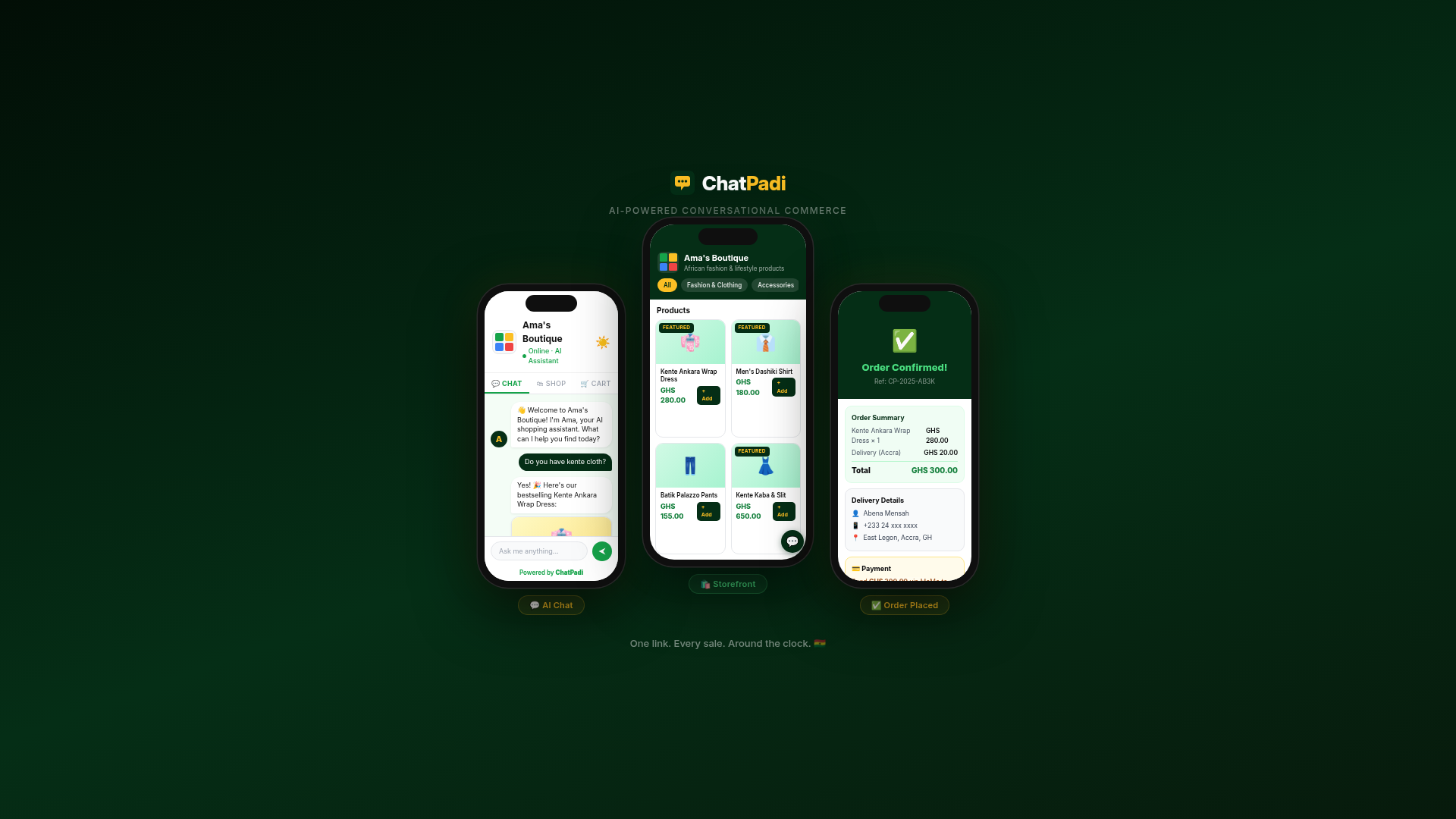
How African Sellers Are Using AI to Run Their Stores 24 Hours a Day

How African Sellers Are Using AI to Run Their Stores 24 Hours a Day
A fashion seller in Lagos who sleeps through hundreds of customer messages and wakes up to confirmed orders. A food business in Accra that takes and processes orders at 2am without the owner being awake. A handmade goods seller in Nairobi whose store answers questions in three languages simultaneously. This is not the future. It is happening right now, and the technology making it possible is more accessible than most sellers realise.
There is a version of running a business that most African sellers know well. You wake up, open WhatsApp, and spend the first hour of your day answering the same questions that arrived overnight. By the time you have replied to every message, responded to every Instagram comment, and confirmed every pending order, it is mid-morning and you have not touched your actual product yet.
There is another version. In this one, you wake up, open your order dashboard, and see exactly which orders came in overnight, which have been paid, and which need to be prepared for dispatch. The questions have been answered, the orders have been taken, the payments have been collected. All of it happened while you slept, handled by an AI agent that never gets tired, never needs a day off, and never sends an incorrect price because it was distracted.
An increasing number of African sellers are living that second version. This article is about how they got there, what it looks like in practice, and how any seller can access the same capability today through a platform like ChatPadi.
The Problem That AI Solves for African Sellers
African commerce is built on messaging. Unlike markets where e-commerce developed through desktop websites and credit card checkouts, commerce across West, East, and Southern Africa developed through personal communication: face-to-face negotiation, phone calls, and increasingly WhatsApp. What millions of African merchants now treat as their online shop is a messaging conversation.
This model has real strengths. It is personal. It builds trust. It works on any phone with any data connection. It uses payment infrastructure, mobile money, that the customer already has and trusts. It does not require the seller to build or maintain a website.
Its fundamental weakness is that it does not scale. Every customer conversation requires a human being to respond. The seller becomes the bottleneck for their own business. They can only grow as fast as they can personally type.
This is the specific problem that AI solves for African sellers in 2026. Not by replacing the personal, conversational nature of African commerce, but by making it possible to have thousands of those personal conversations simultaneously, automatically, without the seller being present for any of them.
What Running a Store 24/7 Actually Looks Like
The phrase “run your store 24/7” can sound like marketing language. It is worth being specific about what it means in practice for sellers across different business types.
Before AI automation, this seller spent three to four hours every day answering WhatsApp messages. The same questions arrived daily: “Do you have this in size 14?” “What materials do you use?” “How long is delivery to Abuja?” “Can I pay by transfer?” She answered each one manually, often losing customers who messaged at night and received no reply until the following morning.
After setting up an AI-powered store with ChatPadi, her AI agent Ama handles all of these questions automatically. Customers who message at midnight receive an instant, accurate response. The seller wakes up to a dashboard showing which conversations happened overnight and which orders were placed and paid. Her average daily selling time dropped from four hours of message management to forty minutes of order fulfilment.
- Orders taken outside business hours: previously zero, now a significant portion of monthly revenue
- Response time: from hours to seconds for every standard question
- Time spent on manual messaging: reduced by over 80%
Food businesses in Africa typically take orders through WhatsApp for same-day or next-day delivery. The challenge is that customers want to order at any time, often in the evening for the following morning, but the seller is unavailable to confirm and accept those orders outside their working hours.
With an AI storefront, the seller’s Ama agent handles the complete order intake conversation in the evening hours when the seller is unavailable. Customers browse the daily menu (updated each morning in the product catalogue), ask about availability, place their order, and pay via Mobile Money within the conversation. The seller checks the dashboard at 7am and starts preparing the day’s confirmed orders with full details already captured.
- Evening orders that previously went unanswered are now captured automatically
- Delivery details collected in the conversation mean no back-and-forth to clarify addresses
- Payment collected upfront via Paystack or Mobile Money eliminates unpaid order waste
Artisan sellers face a particular challenge: their customer base spans multiple time zones. Diaspora customers in the UK or US want to buy gifts for family back home, but their messages arrive at hours when the seller in Nairobi is asleep. Without automation, those customers either wait hours for a reply and often give up, or the seller tries to stay available late into the night to catch international messages.
With an AI agent handling the store, time zones become irrelevant. A customer in London at 10pm local time is served instantly by Ama, who answers questions about the jewellery, confirms availability, collects delivery details, and processes payment via card through Flutterwave. The seller in Nairobi sees the confirmed international order when they wake up.
- Diaspora orders previously lost due to time zone gaps are now captured
- International card payments processed automatically via Flutterwave
- No language barrier: Ama communicates in whatever language the customer uses
Beauty sellers deal with high volumes of product-specific questions. Customers want to know what ingredients are in a product, whether it is suitable for their skin type, how to use it, and whether it will work for a specific concern. These questions are too varied for simple FAQ automation but too repetitive for a seller to answer fresh every time.
An AI agent trained on the seller’s product catalogue, including descriptions, ingredients, usage instructions, and common customer questions, can answer all of these accurately and immediately. It can recommend products based on a customer’s described skin concern, explain the difference between two similar products, and guide the customer from question to purchase within a single conversation.
- Product knowledge questions answered instantly with accurate information from the seller’s own catalogue
- Personalised recommendations increase average order value as customers discover products they did not know to ask about
- Consistency: every customer gets the same accurate information regardless of when they ask
The Technology Making This Possible
The capability that enables this kind of 24/7 selling is not a simple chatbot. Earlier generations of WhatsApp automation, keyword-triggered bots that sent pre-written replies when a customer typed a specific word, were limited and brittle. They could handle simple FAQ responses but broke down immediately when a customer asked something that did not exactly match the expected input format.
The technology that African sellers are using today is built on large language models: AI systems that understand natural language the way a human does, not by matching keywords to scripts but by understanding what the customer actually means. ChatPadi’s Ama is powered by Anthropic Claude, one of the most capable AI models available, trained specifically to handle the kind of conversational, product-focused interactions that African sellers deal with every day.
What the AI agent actually does in each conversation
When a customer messages a ChatPadi store, Ama does not follow a script. She reads the customer’s message, understands what they are asking, checks the seller’s product catalogue and policies for the relevant information, and composes a response that directly addresses what the customer needs. This happens in seconds, for every message, simultaneously across all active conversations.
- Understands informal language, abbreviations, and the natural way that customers type on mobile phones
- Remembers the context of the entire conversation so the customer does not have to repeat themselves
- Makes product recommendations based on what the customer has described, not just what they literally asked for
- Handles multiple topics within a single message without getting confused
- Recognises when a conversation has reached a point that needs human involvement and notifies the seller immediately
- Maintains a consistent, professional, and friendly tone that reflects the seller’s brand regardless of volume or time of day
This is qualitatively different from rule-based automation. It is closer to having a trained, knowledgeable shop assistant available at all times who knows your entire inventory, understands your policies, and can take an order and process payment without ever needing to ask you what to do.
Before and After: A Typical Selling Day
- 6:30am: Wake up, open WhatsApp. 14 unread messages from overnight. Begin replying.
- 7:45am: Still replying. Some customers have already moved on.
- 9am: Start preparing orders, but three new messages have arrived requiring responses.
- Throughout the day: constant interruptions to reply to questions. Focus impossible.
- 8pm: More evening messages arrive. Stay up later to respond so customers do not wait until morning.
- 11pm: Finally offline. Already anxious about tomorrow’s message backlog.
- Revenue ceiling: limited to how many conversations the seller can personally manage per day.
- 7am: Wake up. Open ChatPadi dashboard. See overnight orders, all confirmed and paid.
- 7:15am: Review any escalated conversations that needed human input. Handle those specifically.
- 8am: Start preparing and packing orders from the dashboard list.
- Throughout the day: Ama handles all incoming customer conversations. Focus entirely on fulfilment.
- Evening: No pressure to stay online. Ama continues handling conversations and taking orders.
- Revenue ceiling: removed. Any number of customers can be served simultaneously regardless of seller availability.
What Ama Handles Automatically
Here is a practical breakdown of the specific tasks that Ama manages without any seller involvement:
chatpadi.app/track/[reference] which is sent automatically with every order confirmation.What Ama does not handle alone: Complex complaints, custom bulk orders requiring negotiation, unusual requests that fall outside the catalogue and policies, and any conversation where the customer explicitly asks to speak with a person. These are escalated to the seller immediately with full conversation context included, so the seller can step in with complete knowledge of what has already been discussed.
The Mobile Money Connection
One of the reasons AI-powered selling is particularly well suited to African markets is that the payment infrastructure mobile money already works through conversation. When a customer pays via MTN MoMo, Telecel Cash, or M-Pesa, the transaction happens on their phone, confirmed via SMS or app notification, with no card required and no website checkout needed.
This payment flow fits naturally into a conversational commerce model. For a technical guide on setting up Mobile Money and card payments with webhook automation, OurInternetBusiness.com covers both Paystack and Flutterwave in depth. Ama presents the payment instructions within the chat, the customer initiates the Mobile Money transfer on their phone, and confirmation arrives within the conversation. The entire purchase, from first question to confirmed payment, happens without the customer ever leaving their messaging environment or needing any additional technology beyond the phone they already have.
This is the Africa-specific advantage that global e-commerce platforms built around credit card checkouts have consistently failed to replicate. ChatPadi is designed from the ground up for this reality, supporting Mobile Money alongside Paystack, Flutterwave, Stripe, and cash on delivery so sellers can offer their customers every payment option that matters in their market.
The Shift That Is Happening Right Now
The sellers described in this article are not technology companies or funded startups. For context on the broader automation tools available to African e-commerce sellers, OurInternetBusiness.com has a comprehensive overview: Best Automation Tools for African E-commerce Sellers (2026). They are individual sellers running product businesses from their homes, market stalls, and small shops. What they have in common is that they recognised a specific problem, the one-person messaging bottleneck, and found a tool that solved it without requiring them to learn to code, hire a developer, or invest in expensive software.
According to a 2026 report from Innovation Village, 78% of small businesses in Sub-Saharan Africa already use WhatsApp for sales. Meta itself announced at its Conversations 2026 summit that its AI tools on WhatsApp and Messenger are now handling 10 million business conversations per week, a 10-times increase from January 2026. The infrastructure for AI-powered conversational commerce in Africa is not being built. It is already built. The sellers who are growing fastest are the ones who are using it.
The competitive reality: In any market where AI automation is available, the sellers who adopt it gain a structural advantage over those who do not. They can serve more customers in less time. They can operate outside business hours. They can maintain response quality at scale. Over time, the gap between automated sellers and manual sellers in the same category widens. The question is not whether to automate eventually. It is whether to do it before or after your competitors do.
How to Get Started
Setting up a ChatPadi store, connecting it to WhatsApp, and having Ama handle your customer conversations is a process that takes most sellers under an hour from start to finish. The core steps are:
- Create your free store at chatpadi.com/seller/register and complete the three-step setup wizard
- Add your products with names, descriptions, prices, and photos
- Set your shipping policy, returns policy, and enabled payment methods
- Connect your WhatsApp Business number to give Ama access to your incoming messages
- Share your store link in your Instagram bio, WhatsApp status, TikTok profile, and anywhere else your customers find you
From that point, Ama handles incoming conversations automatically. You check your order dashboard when you are ready to process fulfilment and step in only for the conversations that genuinely need your involvement.
The detailed setup guide is available at How to Set Up Your ChatPadi Store in Under 10 Minutes. The starter tier is free with no credit card required, giving you the opportunity to set up the store, configure Ama, and see the experience from a customer’s perspective before committing to any paid plan.
Join the Sellers Running Their Stores 24/7
Set up your ChatPadi store for free. Add your products. Connect WhatsApp. Share your link. Ama does the rest, day and night, whether you are working, resting, or asleep.
Start Your Free StoreFree to start. No credit card required. Live in under an hour.